Bulgarian Property Terms Explained: Act 16, Notary Deed, Kaparo and More
Type in English, or a Bulgarian word in Cyrillic or Latin letters.
- Ednostaen apartment (studio)
- Dvustaen apartment (one-bedroom)
- Tristaen apartment (two-bedroom)
- Chetiristaen and mnogostaen apartments
- Mezonet (maisonette)
- Kv.m: built, total and living area
- Kaparo (deposit)
- Predvaritelen dogovor (preliminary contract)
- Notarialen akt (notary deed)
- Akt 14
- Akt 15
- Akt 16 (permit for use)
- Palnomoshtno (power of attorney)
- Mesten danak (municipal acquisition tax)
- Notarialni taksi (notary fees)
- Taksa vpisvane (registration fee)
- Agentska komisiona (agency commission)
- Udostoverenie za tezhesti (encumbrance certificate)
- Kadastar (cadastre)
- Notarialen akt za sobstvenost (proof of ownership)
- BULSTAT number
No term matches “”. Ask an agent
Bulgarian property terms decide what you are really buying or renting. A dvustaen listing is a one-bedroom flat, a kaparo can be lost, and a building without Akt 16 cannot legally be lived in. This page explains the 21 terms that foreign buyers and tenants meet in Bulgarian listings, contracts and notary offices, in plain English, with the Bulgarian words transliterated so you can recognise them on paper.
Key takeaways: Bulgarian property terms at a glance
Key takeaways
- Rooms, not bedrooms: a dvustaen (2-room) apartment has one bedroom, because Bulgarian listings count the living room as a room.
- The kaparo is binding money: a buyer who pulls out loses it, a seller who pulls out pays it back twice (Obligations and Contracts Act, Art. 93).
- Akt 16 means you can move in: until the building has its permit for use or certificate of commissioning, nobody can legally live there (Ordinance No. 3 of 2003).
- Only the notary deed makes you the owner: the preliminary contract fixes the price and the dates, the notarialen akt transfers ownership.
- Closing costs in Sofia: 3% municipal tax, notary fees capped at 3 067.75 € plus VAT, a 0.1% registration fee and about 3% agency commission.
- Register within 7 days: a foreign owner without an EGN or LNCh applies for a BULSTAT number within 7 days of the purchase (BULSTAT Register Act, Art. 12).
Apartment types: how Bulgarian listings count rooms
Bulgarian listings describe apartments by the number of rooms (stai), and the living room counts as a room. Take the number in the listing, subtract one, and you have the bedrooms. The table maps each listing term to its English equivalent.
| Listing term | Rooms | English equivalent |
|---|---|---|
| Ednostaen (1-staen) | 1 | Studio |
| Dvustaen (2-staen) | 2 | One-bedroom apartment |
| Tristaen (3-staen) | 3 | Two-bedroom apartment |
| Chetiristaen (4-staen) | 4 | Three-bedroom apartment |
| Mnogostaen | 5 or more | Four bedrooms or more |
| Mezonet | Varies | Maisonette on two levels |
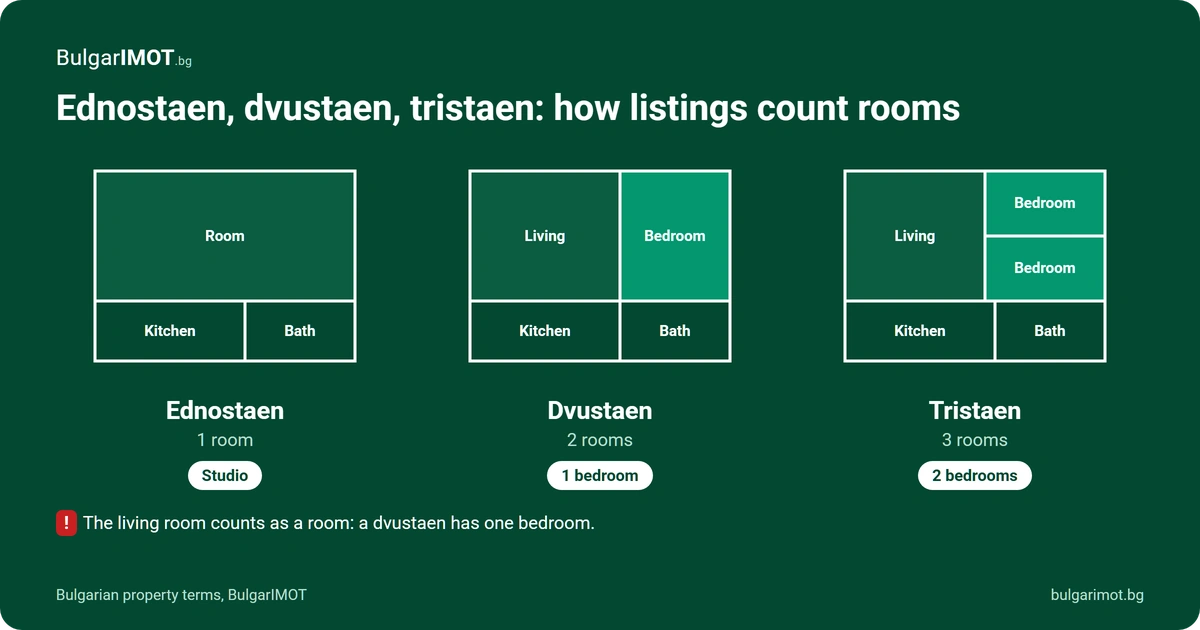
Ednostaen apartment: a studio
In Bulgarian: едностаен апартамент (ednostaen apartament)
An ednostaen apartament (1-staen) has one main room for living and sleeping, plus a kitchen or kitchenette and a bathroom. It is the smallest self-contained flat you will find in a Bulgarian listing.
Dvustaen apartment: a one-bedroom flat
In Bulgarian: двустаен апартамент (dvustaen apartament)
A dvustaen (2-staen) has a living room and one separate bedroom. Dva means two, but the two rooms are the living room and the bedroom, which is why foreign buyers misread it more than any other term. According to BulgarIMOT market data, a dvustaen in Sofia rents for 550 to 650 €/mo across the middle 50% of districts (updated November 24, 2026).
Tristaen apartment: a two-bedroom flat
In Bulgarian: тристаен апартамент (tristaen apartament)
A tristaen (3-staen) has a living room and two bedrooms. If you want two bedrooms, this is the word to search for. In Sofia a tristaen rents for 700 to 850 €/mo across the middle 50% of districts, according to the same BulgarIMOT data.
Chetiristaen and mnogostaen: three bedrooms or more
In Bulgarian: четиристаен (chetiristaen), многостаен (mnogostaen)
A chetiristaen (4-staen) has a living room and three bedrooms, and listings show it as its own category. Mnogostaen covers everything larger. Prices for these flats differ more from building to building, so compare the building first: its age, its construction (panel, brick or reinforced concrete) and how well it is maintained.
Mezonet: an apartment on two levels
In Bulgarian: мезонет (mezonet)
A mezonet is an apartment spread over two floors of a building, joined by an internal staircase. Mezonets are often on the top floors of a block and often come with a terrace.
Kv.m: total area, built area and living area
In Bulgarian: застроена площ (zastroena plosht), обща площ (obshta plosht), идеални части (idealni chasti)
Sizes are given in square metres (kvadratni metri, written kv.m). A listing may quote the built area (zastroena plosht), which includes the walls, or the total area (obshta plosht), which adds the flat’s share of the common parts (idealni chasti) such as the stairwell. The net living area is smaller than both. Ask which figure the listing uses before you compare prices per square metre.
Send us the listing first: we check that it is real, still available, and what its size and room count mean.
Ask an agent →
Buying and renting terms: from kaparo to notary deed
These terms follow the order of a purchase: you reserve the property, sign a preliminary contract, then complete at the notary. A new build adds the construction acts, which tell you how far the building is from being habitable.
Kaparo: the deposit that holds the property
In Bulgarian: капаро (kaparo)
A kaparo is the deposit a buyer or tenant pays to take a property off the market while the paperwork is prepared. Under Article 93 of the Obligations and Contracts Act (lex.bg), a buyer who walks away loses the kaparo, and a seller who walks away pays back double. Pay it only against a signed agreement that states the amount, the deadline for the next step and what happens if either side withdraws.
Predvaritelen dogovor: the preliminary contract
In Bulgarian: предварителен договор (predvaritelen dogovor)
The predvaritelen dogovor is the binding contract signed before the notary appointment. It sets the price, the payment schedule, the completion date and the penalties if one side fails to complete. In Pavlen Avramov’s practice the buyer usually pays 10 to 20% of the price at this stage, and the agency commission falls due on signature. It does not transfer ownership. Have a lawyer read it before you sign, above all for a new build.
Notarialen akt: the notary deed
In Bulgarian: нотариален акт (notarialen akt)
The notarialen akt is the deed signed in front of a notary (notarius) that transfers ownership. The notary checks the identity of both parties and the seller’s title, then the deed is entered in the property register of the Registry Agency (Agentsia po vpisvaniyata). If you do not speak Bulgarian, a sworn translator is usually present at the signing, paid by the party who needs one. You do not need a Bulgarian bank account: the money can be transferred from abroad.
Akt 14: the rough construction is finished
In Bulgarian: Акт 14 (Akt 14)
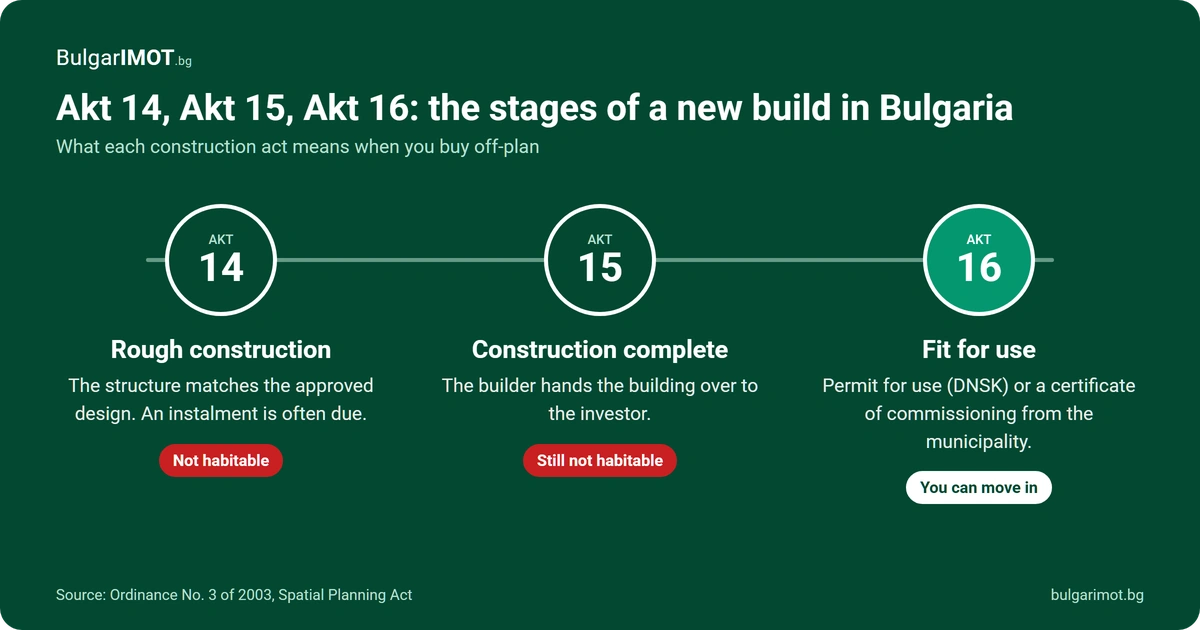
Akt 14 records that the structure of a new building is complete and matches the approved design. At this point the building is a shell. Off-plan payment schedules often release an instalment at Akt 14 (Ordinance No. 3 of 2003 on construction acts and protocols).
Akt 15: the construction is complete
In Bulgarian: Акт 15 (Akt 15)
Akt 15 states that the works are finished according to the design and that the builder can hand the building over to the investor. The building is still not approved for use: you cannot legally move in or register your address there yet. Some developers hand over keys at this stage, so check in your contract what protects you until Akt 16.
Akt 16: the building can be lived in
In Bulgarian: Акт 16 (Akt 16), разрешение за ползване (razreshenie za polzvane)
Akt 16 is the protocol of the acceptance commission confirming that the building is fit for use. For buildings of categories I to III, the Directorate for National Construction Control (DNSK, dnsk.bg) then issues a permit for use (razreshenie za polzvane). Most residential buildings fall into categories IV and V, where the municipality issues a certificate of commissioning (udostoverenie za vavezhdane v eksploatatsia) instead. People say “Akt 16” for both. Until one of them exists, nobody can legally live in the building.
Palnomoshtno: power of attorney
In Bulgarian: пълномощно (palnomoshtno)
A palnomoshtno is a notarised power of attorney that lets a named person sign for you, for example at the notary when you cannot travel. A power of attorney signed outside Bulgaria usually needs an apostille or legalisation and a sworn translation. Agree its exact scope and how long it is valid with your lawyer.
Costs, taxes and fees when you buy
Closing costs come on top of the price. The table shows what a buyer in Sofia should plan for. Outside Sofia, each municipality sets its own tax rate.
| Cost | Rate | Who usually pays | Source |
|---|---|---|---|
| Municipal acquisition tax (mesten danak) | 3% in Sofia, between 0.1% and 3% elsewhere | Buyer, unless agreed otherwise | Local Taxes and Fees Act (ZMDT) |
| Notary fees (notarialni taksi) | Sliding scale, capped at 3 067.75 €, plus 20% VAT | Buyer, unless the contract says otherwise | Notary fee tariff |
| Registration fee (taksa vpisvane) | 0.1% of the price, minimum 5.11 € | Buyer | Registry Agency |
| Agency commission (agentska komisiona) | About 3% of the price | Buyer, at the preliminary contract | Agency terms (Pavlen Avramov) |
Mesten danak: municipal acquisition tax
In Bulgarian: местен данък (mesten danak)
The mesten danak is a one-off tax on the transfer, paid to the municipality where the property is. Sofia charges 3% on the higher of the agreed price and the tax valuation (danachna otsenka), according to Sofia Municipality. The notary signs the deed only after checking that the tax has been paid (ZMDT, Art. 45 and Art. 50).
Notarialni taksi: notary fees
In Bulgarian: нотариални такси (notarialni taksi)
Notary fees follow an official tariff. The percentage falls as the price rises, and the fee for a property transfer is capped at 3 067.75 €, plus 20% VAT. The contract decides who pays, and in most sales it is the buyer. Ask the notary for the exact figure a few days before completion.
Taksa vpisvane: registration fee
In Bulgarian: такса вписване (taksa vpisvane)
The Registry Agency (registryagency.bg) charges 0.1% of the price, with a minimum of 5.11 €, to enter the deed in the property register. Registration is what makes your ownership enforceable against third parties.
Agentska komisiona: agency commission
In Bulgarian: агентска комисиона (agentska komisiona)
When you buy through Homies, BulgarIMOT’s partner agency, the buyer’s commission is about 3% of the price and falls due when the preliminary contract is signed. For a residential rental it is one month’s rent. The amount is confirmed in writing before any viewing.
As a rough estimate, budget several percent above the purchase price for taxes, notary costs, registration and commission. The exact total depends on the municipality and on how the deal is structured.
We work out the figures with the notary before you commit, so completion day brings no surprises.
Contact a real estate agent →
Documents and registers to check before you sign
Before the notary appointment, these documents tell you who owns the property, what exactly it is and whether anything is registered against it.
Udostoverenie za tezhesti: encumbrance certificate
In Bulgarian: удостоверение за тежести (udostoverenie za tezhesti)
The udostoverenie za tezhesti is issued by the Registry Agency and lists what is registered against the property: mortgages, seizures (vazbrani), registered claims and similar charges, for the period you request. If it shows a mortgage, your lawyer agrees with the seller how it will be cleared before or at the signing. Order a fresh certificate just before the notary date, and never skip it when you buy with a mortgage.
Kadastar: the cadastre and the property identifier
In Bulgarian: кадастър (kadastar), кадастрален идентификатор (kadastralen identifikator), скица (skitsa)
The kadastar is the national map of land plots and buildings, kept by the Geodesy, Cartography and Cadastre Agency (AGKK, cadastre.bg). Every property has a unique cadastral identifier (imoten identifikator) used in all its documents. The cadastral sketch (skitsa) shows boundaries and area: compare it with the notary deed during your checks.
Notarialen akt za sobstvenost: proof of ownership
In Bulgarian: нотариален акт за собственост (notarialen akt za sobstvenost)
The seller proves ownership with the notary deed through which they acquired the property, or with another title document such as a succession document. Ask early for a copy, together with the tax valuation, the cadastral sketch and the encumbrance certificate. After your purchase, your own notary deed is the proof that you own the property, so keep the original safe.
BULSTAT: the owner’s registration number
In Bulgarian: БУЛСТАТ (BULSTAT)
BULSTAT is a register kept by the Registry Agency for people and entities that have no other Bulgarian identifier. A foreign individual who buys property and has no Bulgarian personal number (EGN or LNCh) must apply for a BULSTAT number within 7 days of the purchase (BULSTAT Register Act, Art. 3 and Art. 12). Your notary or lawyer can file the application. Confirm the other steps after the purchase with your lawyer or accountant.
Where foreign buyers misread these terms
Pavlen Avramov runs Homies, the partner agency that handles BulgarIMOT’s purchases and rentals. These are the mistakes he sees most often with clients from abroad.
- Reading bedrooms in the listing title. A buyer asks for a “two-bedroom” and gets shown dvustaen flats. Ask for a tristaen instead.
- Trusting a cheap listing. Many low-priced ads are already sold or rented, years old, or posted by an agency that does not control the property. Send us the link first: we check that it is real, still available and who represents it.
- Paying a kaparo on a handshake. Without a written agreement, you have no terms to rely on if the deal falls apart.
- Treating Akt 15 as Akt 16. A building can look finished and still be waiting for its permit for use. No developer is risk-free: look at their past projects and reputation, and have a lawyer review the contract.
- Skipping checks because you pay cash. A cash purchase goes through the same legal checks, document review and notary process.
- Waiting too long. Well-priced properties go quickly, and buyers who hold out for a price below the market often lose them.
If a check shows a legal risk, we advise you to walk away rather than sign. We show you the real market, not one or two properties, and the decision stays yours.
You will meet these terms when renting an apartment in Sofia, buying an apartment in Bulgaria, investing in Bulgarian property or handing your flat to a property management team.
Send it to us before you sign. An agent who knows the local paperwork will go through it with you in English.
Speak with an agent →
Frequently asked questions about Bulgarian property terms
What does a 2-bedroom apartment mean in Bulgaria?
In Bulgaria, a 2-bedroom apartment is called a tristaen (3-room) apartment, because listings count the living room as a room. A listing that says dvustaen (2-room) has only one bedroom. To find two bedrooms, search for tristaen and check the floor plan. The room table above gives every listing term with its English equivalent.
What does notarial deed mean in Bulgaria?
A notarial deed (notarialen akt) is the document signed before a Bulgarian notary that transfers ownership of a property. The preliminary contract does not make you the owner: the deed does, once it is entered in the property register of the Registry Agency. The notary checks the identity of both parties and the seller’s title before the signing.
When does the deposit have to be paid when buying property in Bulgaria?
A buyer in Bulgaria usually pays a deposit at two moments before completion. A reservation deposit (kaparo) takes the property off the market while the documents are checked. At the preliminary contract, the buyer typically pays 10 to 20% of the price, according to Pavlen Avramov’s practice. The balance is paid at the notary. Pay each amount only against a signed document that says what happens if either side withdraws.
Do you get the deposit back if the purchase falls through?
Whether you get a deposit back in Bulgaria depends on who withdraws. Under Article 93 of the Obligations and Contracts Act (lex.bg), a buyer who pulls out loses the kaparo, while a seller who pulls out must return double. If the deal fails for a reason the contract foresees, such as a refused mortgage, the contract terms apply. Write those conditions into the agreement before you pay.
What is a notary fee in Bulgaria and who pays it?
A notary fee in Bulgaria is the charge for preparing and certifying the deed, set by an official tariff. The rate falls as the price rises, and the fee for a property transfer is capped at 3 067.75 €, plus 20% VAT. The contract decides who pays, and in most sales the buyer covers it, together with the 0.1% registration fee and the municipal tax.
Can a British person buy a house in Bulgaria?
A British person can buy an apartment in Bulgaria in their own name. Houses with land and building plots are different: non-EU buyers may need a Bulgarian company structure, such as an EOOD, and this must always be checked with a lawyer before you go ahead. Our partner company-registration.bg sets up Bulgarian companies if your lawyer recommends that route.
How long can I stay in Bulgaria if I own a property?
Owning property in Bulgaria does not on its own give you the right to stay. EU and EEA citizens can live in Bulgaria under free movement rules. Non-EU visitors, British citizens included, follow the Schengen limit of 90 days in any 180-day period, as Bulgaria has been a full Schengen member since January 2025. Buying property may support a residence application in some cases, especially for larger investments, but the requirements depend on your nationality, the amount, the payment structure and the legal basis. Consult an immigration lawyer before relying on a purchase for residence.
What should I be careful of when buying property in Bulgaria?
When buying property in Bulgaria, be careful with listings that are not real, with deposits paid without a written agreement, and with new builds that have no Akt 16. Ask for the encumbrance certificate and the cadastral sketch, check in the notary deed who owns the property, and have a lawyer read the preliminary contract. Send us any listing before you contact the seller: we check that it exists, is still available and who represents it.
Methodology and sources
This page was written by the BulgarIMOT team with Pavlen Avramov, who runs Homies, BulgarIMOT’s partner agency, from the questions his foreign clients ask during real purchases and rentals. Legal definitions were checked against these sources:
- Obligations and Contracts Act (ZZD): lex.bg
- Local Taxes and Fees Act (ZMDT) and Sofia rates: sofia.bg
- Registry Agency and BULSTAT Register Act: registryagency.bg
- Directorate for National Construction Control (DNSK) and Ordinance No. 3 of 2003: dnsk.bg
- Geodesy, Cartography and Cadastre Agency (AGKK): cadastre.bg
- Rent figures: BulgarIMOT market data listings, updated November 24, 2026
This page is general information, not legal or tax advice. For Act 16 status, taxes, residence or company structures, consult a qualified Bulgarian lawyer or accountant. Company formation is handled by our partner company-registration.bg. Current properties are on the BulgarIMOT property listings.
Last updated: 6 October 2026.